
The Aging U.S. Power Grid and the Drilling Work Behind Its Rebuild
June 5, 2026 · 8 min read · By Thomas Charles
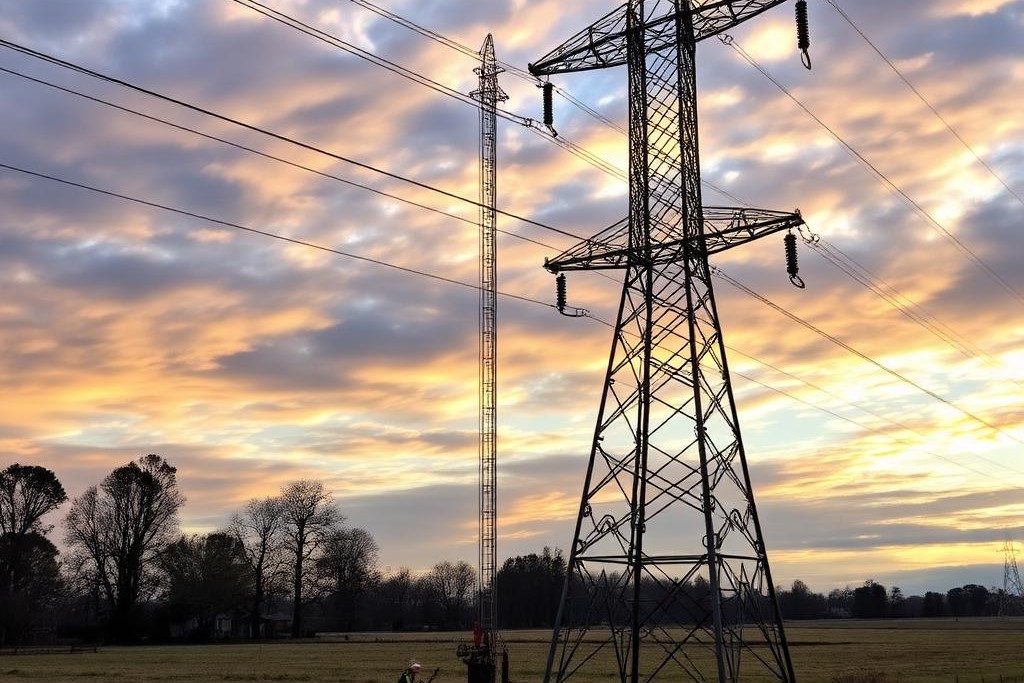
The most consequential infrastructure story in America isn't happening in a high-tech lab or a flashy press conference. It’s happening in muddy rights-of-way, remote ranch land, and aging suburban power corridors. The country is rebuilding its electrical grid, tower by tower, at a scale not seen in most of our lifetimes. Utility filings, integrated resource plans, and interconnection queues all point to the same unglamorous reality: a sustained, multi-decade wave of transmission and distribution work. For those of us in the commercial drilling industry, this isn't an abstract headline. It’s a backlog. Behind every new transmission line, every replaced tower, and every expanded substation is a series of deep holes drilled into the earth. Without those foundations, the grid goes nowhere.
The A-Frame Has a Geriatric Problem
A huge share of the American grid was erected in the two decades following World War II, with another build-out cycle in the 1970s and early 1980s. These steel lattice towers and wood H-frame structures were marvels of their time, but nothing lasts forever. Most were designed with a 50- to 80-year service life. That clock is now hitting zero all across the country. The steel fatigues, the wood rots, and the original concrete footings begin to spall and degrade. It’s the same as any other physical asset. A 70-year-old bridge or building would be under intense scrutiny; our grid infrastructure is no different.
This isn’t just about age. The demands on the grid have fundamentally changed. Population centers have migrated and expanded. Entirely new industries have appeared, from sprawling data center campuses to electric vehicle manufacturing plants, creating concentrated load pockets that didn’t exist ten years ago. Add to that the geographic redistribution of power generation, with wind and solar farms being built where the resource is, not necessarily where the people are. The grid we have was not designed to carry the power we need from the places we now generate it to the places we now use it.
Out With the Old, In With the Heavy
Replacing a 1960s-era transmission tower is rarely a simple one-for-one swap. The new structures are almost always taller and heavier, and for good reason. Modern engineering standards, particularly ASCE 7, mandate resilience to higher wind speeds and greater ice loading. Utilities are also using the opportunity to increase the line’s capacity, or ampacity, which requires larger, heavier conductor wires. A taller tower provides the necessary ground clearance for these new conductors, and the entire assembly weighs significantly more than the structure it replaces.
This is where our work begins. The original foundations, often simple concrete spread footers or buried grillage systems, are wholly inadequate for these new, heavier towers. Before the old tower can come down, our crews have to install the foundation for the new one right next to it. That means drilling deep shafts, often three to eight feet in diameter and anywhere from 20 to over 100 feet deep. On a recent project, our operating company used its CZM LR160 rig to drill 6-foot diameter shafts 75 feet deep for a new 345kV line, boring through layers of clay and shale just a few yards from the energized, existing line.
The Invisible Work of Access
Some of the most challenging work on a transmission project happens before the first yard of dirt is drilled. Many of these towers are in the middle of nowhere: agricultural fields, dense woods, or rugged hillsides. You can’t just drive a 150,000-pound drill rig, a Cat 308 excavator, and a convoy of concrete trucks to the site. First, you have to build a road. This initial phase of access and site preparation is a critical, and often underestimated, part of the job.
Our crews rely on equipment like Cat 299D3 XE track loaders to clear and grade temporary access roads and create a level, stable pad for the drill rig. Every piece of equipment, every rebar cage, every bucket of concrete arrives via this path. A JLG 2733 telehandler might be used to offload materials from the Western Star 49X lowboy trailers that brought them in. Any failure in this logistics chain has a direct impact on the schedule. A day lost waiting for a bulldozer to clear a path is a day the rig sits idle, and a day the entire multi-million-dollar project falls behind.
Dueling with the Unknown Below
No matter how thorough the planning, the real test begins when the auger bites into the ground. Every drilled shaft is a battle against geological uncertainty. The geotechnical report, based on soil borings, gives us the blueprint. It tells us if we should expect soft clays, running sands, solid bedrock, or a frustrating mix of all three. But reports can miss things. A single, unanticipated rock floater or a seam of groundwater can bring a project to a halt.
This is what separates experienced crews from the rest. When a hole starts to collapse, they know to use temporary steel casing to stabilize it. If they hit a layer of hard rock, they swap the dirt auger for a core barrel or rock socket tooling. For unstable ground, they might employ slurry drilling, using a bentonite mixture to maintain hydrostatic pressure and keep the hole open until concrete can be tremied in. The CZM LR160 rig has the torque and the auxiliary systems to handle these changing conditions, but it’s the operator’s judgment that makes the difference. It’s a high-stakes decision-making process, happening in real time, with the project’s schedule and budget on the line.
Substations: The Crowded Nerve Centers
The work isn’t just out on the line. Every transmission line begins and ends at a substation, and these nerve centers are undergoing massive expansion. Growth in AI is fueling a data center building boom, and each new campus requires a dedicated substation. The shift to EVs and the build-out of renewable energy projects all require new or expanded switchyards to connect to the grid. Every new circuit breaker, transformer, and bus support sits on a concrete foundation, and most of those are drilled.
Working inside an existing, or brownfield, substation is a different challenge. The tolerances are tighter, and the logistics are more complex. You’re often drilling within feet of energized, multi-million-dollar equipment. Precision is paramount. This work often involves smaller diameter rock sockets and anchor bolts, requiring a different tooling setup. Access is tight, and our crews have to move equipment like the Ford F-450 work trucks and compact excavators carefully through a maze of live gear. It’s surgical work, not bulk earthmoving.
The High Cost of a Crew Shortage
The convergence of an aging grid, new load demands, and the energy transition has created a predictable surge in demand for foundation drilling. What was less predictable is how few companies are equipped to meet it. This isn’t a business you can start with a pickup truck and a shovel. The capital investment is immense. A new hydraulic rotary rig like the LR160 costs millions, and the support equipment of excavators, loaders, and trucks adds millions more. Finding, training, and retaining a skilled crew that can operate this equipment safely and efficiently is perhaps the single greatest challenge.
This structural scarcity of qualified subcontractors creates a significant bottleneck for the entire grid rebuild. A utility and its prime contractors can have the permits, the financing, and the towers for a hundred-mile transmission line, but if they can’t get a drilling crew, nothing happens. The project schedule is dictated by the availability of this one specialty trade. This is the environment where a company like DrillingCrust Holdings operates. We provide capital and lease critical equipment—the rigs, the earthmoving machines, the transport—to qualified operating companies that have the crews and master service agreements to execute the work. We focus on getting the right iron into the hands of the right people.
One Mandate, Many Regions
While the need for new foundations is universal, the specific drivers vary by region. In Texas, the ERCOT grid is strained by the need to connect massive wind and solar generation in the west to load centers like Dallas and Houston, plus the exponential growth of power-hungry data centers. In the Mid-Atlantic’s PJM territory and the Midwest’s MISO footprint, the story is a mix of replacing ancient infrastructure and preparing for a huge influx of renewable projects, including offshore wind interconnections that require entirely new onshore transmission routes.
Out West, in states covered by CAISO and the broader WECC, utilities are focused on fire-hardening the grid by replacing wood poles with steel, a process that requires new drilled foundations for nearly every structure. They are also building the long-haul transmission needed to bring solar and wind power from remote deserts and plains to coastal cities. The geology, weather, and regulations change from state to state, but the fundamental task does not. A drilling crew in Pennsylvania and one in California are solving the same basic problem: installing a robust foundation capable of supporting critical infrastructure for the next 80 years. This work isn’t a short-term boom; it’s the new normal.
The most consequential infrastructure story in America is not glamorous: the country is rebuilding its power grid, tower by tower, at a pace not seen in a generation. Utility filings, integrated resource plans, and interconnection queues all point the same direction — sustained, multi-decade transmission and distribution work. Behind every one of those projects is a drilled foundation.
Why the grid needs a rebuild
A large share of U.S. transmission was built between the 1950s and the early 1980s. Steel lattice towers, wood H-frames, and older concrete substation pads are reaching or exceeding their design lives. At the same time, load patterns have shifted: population centers have moved, industrial load has grown, and renewables have concentrated in geographies that were never served by legacy transmission.
What that rebuild requires on the ground
Replacing a transmission tower is rarely a one-for-one swap. Modern towers are heavier, taller, and designed to newer wind and ice loading standards. That means the existing foundations are often insufficient, so drilled shafts have to be installed alongside the old foundation before the new tower can be erected. Substation expansions follow the same pattern — the switchyard grows, transformer counts increase, and every new piece of equipment sits on drilled anchors.
Regional dynamics
The rebuild is not uniform. PJM, MISO, ERCOT, and the western grids each have their own drivers. What they share is a shortage of qualified specialty subcontractors. Utilities can plan a project, but they cannot pour concrete without a drilling crew. That structural scarcity is what makes commercial drilling a critical part of the buildout story.
Working in commercial drilling?
Reach out to a DrillingCrust representative to talk projects, partnerships, or the fleet.

A holding company operating across the U.S. commercial drilling industry. We invest capital, provide funding, and lease equipment to established operators building the foundations of modern American infrastructure.
Contact
© 2026 DrillingCrust Holdings LLC. All rights reserved.