
Powering AI: How Data Center Growth Is Reshaping Foundation Drilling Demand
May 29, 2026 · 8 min read · By Thomas Charles
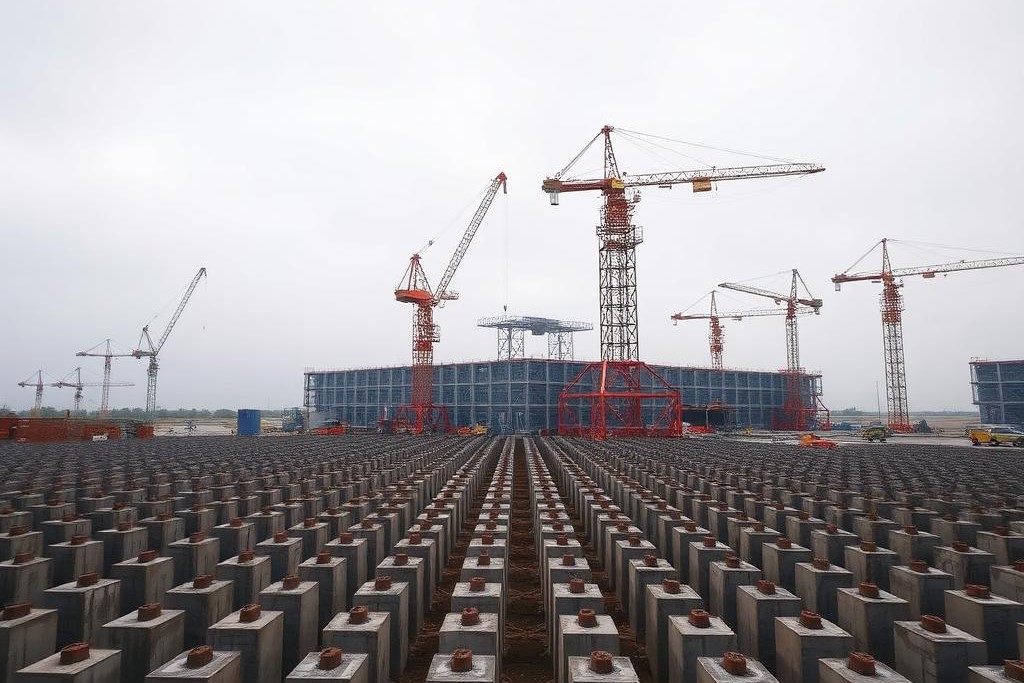
The world talks about artificial intelligence in terms of algorithms and silicon, but those are just the ghosts in the machine. The machine itself is a physical thing—a sprawling, power-hungry beast called a hyperscale data center. And before the first server rack is installed, before the first fiber optic cable is pulled, the very first critical path item is putting holes in the ground. The AI boom, for those of us who work with steel and dirt, is a drilling boom. It’s a heavy-civil challenge on a scale most people can’t grasp, and it all begins with the foundation.
The Unseen Foundation of the Cloud
Hyperscale data centers are some of the heaviest industrial buildings ever conceived. A typical multi-story data hall has a floor loading capacity that dwarfs a standard warehouse, designed to support row after row of server racks that weigh a ton apiece. But the real weight isn’t just the servers; it’s the power and cooling infrastructure. A single lineup of 15kV switchgear can weigh as much as a house. The backup power systems, comprising massive diesel generators and uninterruptible power supply (UPS) batteries, add hundreds of tons. Then there’s the cooling—industrial chillers, cooling towers, and enormous pipes filled with water. All this mass sits on a concrete slab that must remain perfectly stable for decades.
This is where the drilling comes in. You cannot support this kind of concentrated load on a simple shallow foundation. The only way to guarantee stability and prevent settling over the 30- to 50-year lifespan of the facility is to transfer the load deep into the earth. We drill shafts, often hundreds of them per building, through unstable soils until we reach competent bedrock or a geologic stratum with the required bearing capacity. These drilled piers, filled with reinforced concrete, act as legs for the building, anchoring it to something that won’t move.
The engineering is precise. Geotechnical engineers analyze soil borings to determine the exact depth and diameter required for each pier. On a site with variable geology, a single building might require shafts of a dozen different depths, from 20 feet to over 100 feet deep. In areas with hard rock, we drill rock sockets—a hole drilled into the bedrock itself—to ensure a permanent, high-capacity anchor. The process is meticulous, involving careful slurry management to keep the hole from collapsing and precise positioning of the steel reinforcement cage. For an AI data center, where even microscopic vibrations can be a concern for sensitive equipment, getting this foundation perfect is not optional.
The Second Wave: Powering the Beast
A single hyperscale data center campus can consume more electricity than a medium-sized city. We’re no longer talking about megawatts; the new standard unit of measurement for data center load is the gigawatt. Utilities in hotspots like Northern Virginia, Central Ohio, and Phoenix are seeing connection queues measured in the tens of gigawatts. This staggering demand creates a second, parallel wave of drilling work that happens outside the data center’s property line.
To deliver that much power, utilities must build entirely new infrastructure. This means new high-voltage transmission lines, often stretching for miles to tap into the main grid. Each of those towering steel lattice structures or monopoles requires a massive drilled foundation to resist the immense cantilever forces from wind and the weight of the lines themselves. The bigger the voltage, the bigger the tower, and the bigger the foundation. Drilling a 10-foot diameter, 80-foot deep pier for a 500kV transmission tower is a standard operation in this business.
Adjacent to the data center campus, a new substation must be built. This isn’t a small pad with a couple of transformers; it’s a multi-acre facility in its own right. It’s filled with circuit breakers, busbars, switchgear, and control buildings, all of which sit on drilled pier foundations. So for every large data center project, there’s an equally critical utility project, and both are fundamentally drilling-intensive. This compounding effect is what’s driving unprecedented demand for specialized drilling contractors who can operate on both sides of the fence.
The Right Iron for the Job
You can’t just show up to a hyperscale site with any old drill rig. The scale, speed, and precision required filter out most of the field. The key piece of equipment is the hydraulic rotary rig. Our primary asset, a CZM LR160, was selected specifically for this type of work. Its high-torque rotary head is essential for turning large-diameter augers and core barrels through difficult ground, whether it’s sticky clay or hard limestone. Torque is what gets the job done when you’re drilling a 72-inch diameter shaft 60 feet down.
But the rig is only part of the equation. Site logistics are intense. These are crowded, fast-moving jobsites with dozens of other trades working simultaneously. You need a full complement of support equipment to be efficient. Our Cat 308 excavators are constantly at work, clearing spoils from the hole, managing slurry, and placing reinforcement cages. We rely on JLG 2733 telehandlers for moving tooling and materials around the site. It’s a synchronized dance, and any weak link can bring the whole operation to a halt.
Getting the equipment to and from these sites is another major factor. Data center construction is clustered in specific geographic regions. Having the mobility to move a 160,000-pound rig from a site in Ohio to another in Georgia is critical. That’s the role of our Western Star 49X tractors and specialized lowboy trailers. Our Ford F-450 work trucks, outfitted with tools and parts, provide the field support that minimizes downtime. Owning and managing the entire logistics chain gives a contractor the ability to control schedules and meet the aggressive timelines these projects demand.
Executing Under Pressure
The schedules on data center projects are brutal. The time-to-market for the tech companies that own them is measured in billions of dollars. That pressure flows downhill directly to the trades. For a drilling contractor, that means being able to mobilize multiple crews and run double shifts, sometimes 24 hours a day, to meet foundation deadlines. A delay in drilling has a cascading effect, holding up the concrete crews, the steel erectors, and everyone else that follows. There is zero room for error.
Common pitfalls can derail a project quickly. Using the wrong drilling tool for the geology—a dirt auger in a field of boulders, for example—can break equipment and cause weeks of delay. Improper slurry management can lead to a collapsed hole, requiring a costly and time-consuming re-drill. On these sites, quality control is as important as speed. Every drilled shaft is inspected. This often involves lowering a camera down the hole to verify its cleanliness and integrity, or using sonic logging to test the concrete’s quality after the pour. Failed tests are not an option.
Success requires more than just equipment; it requires an experienced crew. The driller operating the rig, the support crew on the ground—these are not entry-level jobs. They are skilled tradespeople who understand the geology, know how to interpret the feel of the machine, and can solve complex problems on the fly. This is the human element that no amount of capital equipment can replace. It’s the deep, hands-on expertise that allows an operator to navigate the immense pressures of building the foundation of the digital world.
The New Bedrock of the Economy
The AI and cloud computing revolution is not just happening in the cloud. It’s happening in the dirt, on sprawling construction sites across the country. It’s a blue-collar building boom driven by white-hot technology. The forces reshaping the 21st-century economy are being built on a foundation of drilled concrete and steel.
For companies in the commercial drilling industry, this represents a generational shift. The demand profile is clear: large-diameter shafts, deep holes, complex geology, and unforgiving schedules. Succeeding in this environment requires a specific business model—one that emphasizes modern, high-torque equipment, logistical independence, and crews with the institutional knowledge to execute flawlessly under pressure. Our model of investing in and leasing this exact combination of assets to operators is built to meet this moment.
As long as the demand for data continues its exponential rise, the demand for the physical infrastructure to support it will follow. From the on-site building foundations to the off-site transmission lines that power them, drilling is the critical first step. It’s the unseen but essential work that makes the entire digital world possible.
The AI boom is often narrated in terms of chips, models, and cloud contracts. But if you follow the work into the physical world, most of it lands in one place: new hyperscale data center campuses. And the very first trade on those campuses is not electrical, not mechanical, and not structural. It is drilling.
Why data centers need so much drilling
Modern hyperscale data centers are heavy buildings. Their power distribution equipment is heavier still. The cooling infrastructure, the emergency generators, the substation feeders — all of it sits on drilled piers designed to keep the building level for decades and to survive local wind, seismic, and freeze-thaw conditions. Add to that the grounding systems that AI-scale electrical loads demand, and you have hundreds of drilled shafts per site before the first slab is poured.
Load growth is compounding
Estimates for U.S. data center power demand vary, but the direction of travel is unambiguous. Utilities in Northern Virginia, Ohio, Arizona, Georgia, Texas, and the Pacific Northwest are absorbing gigawatts of new load requests each year. To interconnect that load, they have to build new substations and new transmission — which means more drilled foundations, this time on the utility side of the fence.
So each new hyperscale campus generates two waves of drilling work: the on-site work at the campus itself, and the off-site utility work required to feed it.
What contractors need to capture the wave
To keep up with data-center-driven demand, an operator needs three things: a modern rotary rig with sufficient torque for large-diameter shafts, mobility to reach clustered project geographies, and a crew capable of working under aggressive schedules. Our flagship asset — the CZM LR160 — was chosen with exactly this profile in mind.
Working in commercial drilling?
Reach out to a DrillingCrust representative to talk projects, partnerships, or the fleet.

A holding company operating across the U.S. commercial drilling industry. We invest capital, provide funding, and lease equipment to established operators building the foundations of modern American infrastructure.
Contact
© 2026 DrillingCrust Holdings LLC. All rights reserved.