
Drilled Shafts vs. Driven Piles: Picking the Right Deep Foundation
May 8, 2026 · 7 min read · By Thomas Charles
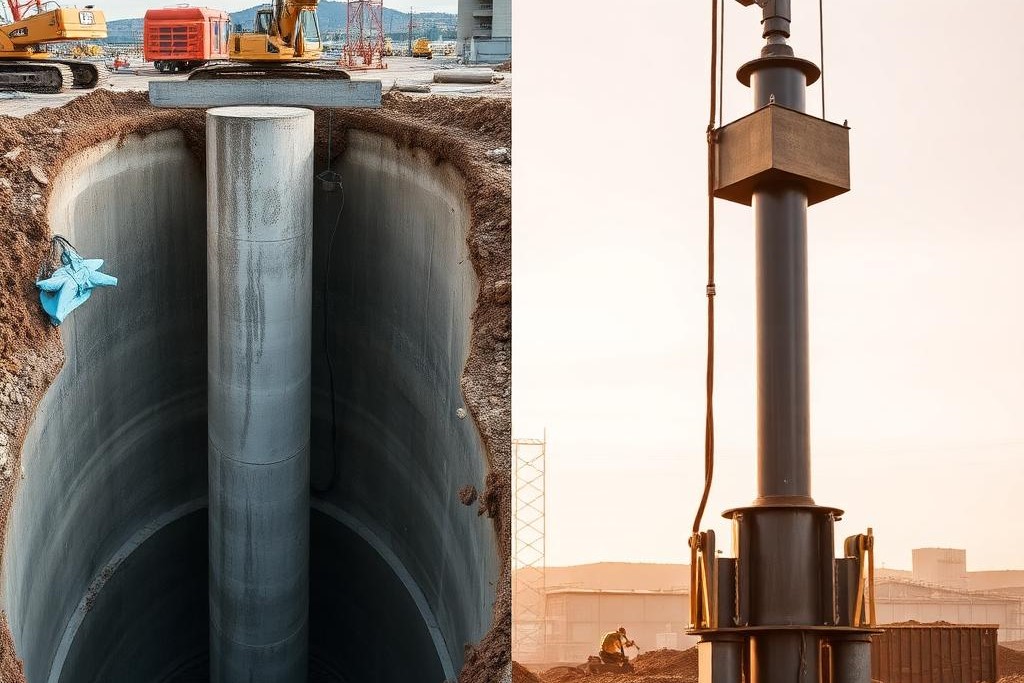
The ground doesn’t care about your schedule. It doesn’t care about your budget, the urgency of the power grid upgrade, or the market demand for a new data center. It is what it is: a complex, layered, and often wholly inconvenient mix of soil, rock, and water. The first job of any significant structure is to bypass the weak, unreliable upper layers and anchor itself to something solid. This is the work of deep foundations, and for most heavy commercial, industrial, and infrastructure projects, the choice boils down to two distinct paths: drilled shafts and driven piles. They solve the same fundamental problem, but in ways so different that the choice, made early, will dictate the cost, schedule, risk profile, and ultimate constructability of the entire project. Understanding the trade-offs is not just an engineering exercise; it’s the bedrock of a successful build.
The Core Problem: Moving the Load
At its heart, a deep foundation is a load-transfer mechanism. It takes the concentrated structural loads from a building column, a bridge pier, or a transmission tower and moves them down through weak or compressible soils—unconsolidated fill, organic clays, loose sand—into a competent bearing stratum. This load transfer happens in two ways, often simultaneously: end bearing and side friction (or skin friction). End bearing is straightforward; the foundation element acts like a leg, resting directly on a strong layer of rock or dense soil. Side friction is the resistance generated along the entire length of the element’s vertical surface, gripping the surrounding soil.
Both drilled shafts and driven piles utilize these principles, but they go about it with opposing philosophies. A drilled shaft is a cast-in-place solution, a column of concrete and reinforcing steel custom-built within the ground itself. A driven pile is a prefabricated structural element, typically steel or concrete, which is forced into the ground using brute force from a hammer or vibrator. This distinction—manufacturing the foundation in the ground versus manufacturing it offsite and installing it—is the central point of divergence that controls everything else.
The geotechnical report is the bible for this decision. It provides the subsurface map, detailing soil types, layer depths, density, strength, and groundwater levels. A seasoned driller or engineer reads this report not just for what it says, but for what it implies. Vague soil descriptions, unexplained anomalies, or wide gaps between borings are all red flags that signal potential risk, and they weigh heavily in the decision between a system you can adapt on the fly versus one that is locked in from the start.
The Drilled Shaft: A Custom-Engineered Solution
A drilled shaft is a product of on-site industrial surgery. The process begins with a large hydraulic rotary rig, like our operating companies’ CZM LR160s, turning a heavy-duty auger to excavate a cylindrical hole. As the auger penetrates the ground, soil spoils are brought to the surface and managed by a support excavator, such as a Cat 308. If the hole is unstable due to loose soil or groundwater, two options exist: temporary steel casing can be advanced with the hole, or the hole can be stabilized with a mineral or polymer slurry. This ability to actively manage ground conditions during installation is a critical advantage.
Once the hole is advanced to the target depth, a clean-out bucket is used to ensure the bottom is flat and free of loose material, which is essential for achieving proper end bearing. The drilling crew then lowers a prefabricated cage of reinforcing steel into the hole. Finally, concrete is placed via a tremie pipe, which extends to the bottom of the hole. The concrete fills the shaft from the bottom up, displacing the slurry or water and ensuring a continuous, monolithic concrete column, free of voids or inclusions. The finished product is a high-capacity, custom-engineered foundation element.
This process allows for tremendous design flexibility. Shaft diameters can range from two feet to over twelve feet, with depths exceeding 200 feet. Most importantly, if the design calls for anchoring directly into bedrock to handle immense loads or resist uplift, the rig can swap out the auger for a core barrel and create a rock socket—a solution that is simply not possible with driven piles. This makes shafts the clear choice for things like major substation equipment, wind turbines, and the massive columns supporting modern data center halls.
The Driven Pile: Brute Force and Repetition
If a drilled shaft is surgery, a driven pile is a production line. The process is defined by repetition and speed in the right conditions. Piles—prefabricated lengths of steel (H-piles or pipe piles) or precast concrete—arrive at the site on a truck, ready to install. A large crane lifts a pile into position, and a pile-driving hammer does the rest. Impact hammers, powered by diesel or hydraulics, repeatedly strike the top of the pile, driving it into the ground with powerful blows. Vibratory hammers use a different approach, using high-frequency oscillations to liquefy the soil directly around the pile, allowing it to sink with its own weight plus that of the hammer.
The appeal is obvious. In uniform soil conditions, like deep alluvial sands and clays found near rivers, an experienced crew can drive dozens of piles in a single shift. There is no waiting for concrete to cure, and no spoil removal to manage. The quality control is also different; instead of inspecting a drilled hole, the crew monitors the "blow count" for an impact hammer—the number of blows required to drive the pile a set distance—or the amperage draw on a vibratory hammer. This data, correlated with the geotechnical information, confirms when the pile has reached the required bearing capacity.
However, this efficiency comes with significant trade-offs. The noise is immense and relentless, a non-starter for projects near residential areas, hospitals, or schools. More critically, the intense vibrations transmitted through the ground can damage nearby structures or disrupt sensitive industrial processes. This factor alone often eliminates driven piles from consideration for work in dense urban areas or for upgrades at operating semiconductor fabs or data centers.
Ground Conditions: The Ultimate Arbiter
The choice between drilling and driving is almost always dictated by the ground. A good operator can look at a geotechnical boring log and immediately see which system is viable and which is a recipe for disaster. For instance, ground littered with cobbles, boulders, or man-made debris from previous construction presents a major risk for driven piles. A pile can hit one of these obstructions and "refuse" long before it reaches its target depth, causing schedule delays and costly arguments about who is responsible.
Drilling rigs, by contrast, can chew through many of these obstructions. A rock auger can handle smaller boulders, and the operator can see the obstruction in the spoils and react accordingly. If a truly massive and unmovable object is encountered, the hole can be shifted slightly—an option that doesnt Deep foundations exist to move structural loads past weak surface soils and into competent material below. Two of the most common systems — drilled shafts and driven piles — do this in fundamentally different ways. Understanding the trade-offs is a big part of what makes a commercial drilling operator valuable to a general contractor.
How each system works
A drilled shaft is a cast-in-place concrete column installed in a hole that has been advanced by a rotary drilling rig. A driven pile is a prefabricated element — usually steel or concrete — that is hammered or vibrated into the ground. Both develop capacity through side friction and end bearing, but they behave differently in different soil profiles.
Where drilled shafts win
Drilled shafts shine when loads are large and concentrated, when noise and vibration have to be controlled near sensitive structures, or when the geology calls for socketing into rock. They are the default choice for transmission tower foundations, substation equipment pads, and much of the heavy foundation work supporting data centers and industrial facilities.
Where driven piles win
Driven piles can be very efficient in deep, uniform soils where installation speed matters and vibration is acceptable. Bridge foundations in soft alluvial soils are a classic example.
Choosing well
The right answer is site-specific. A good drilling contractor helps the general contractor and engineer of record think through the trade-offs early — before the schedule is locked in and the wrong system is already on the drawings.
Working in commercial drilling?
Reach out to a DrillingCrust representative to talk projects, partnerships, or the fleet.

A holding company operating across the U.S. commercial drilling industry. We invest capital, provide funding, and lease equipment to established operators building the foundations of modern American infrastructure.
Contact
© 2026 DrillingCrust Holdings LLC. All rights reserved.