
Reading a Geotechnical Report: What Drillers Look For First
April 17, 2026 · 7 min read · By Thomas Charles
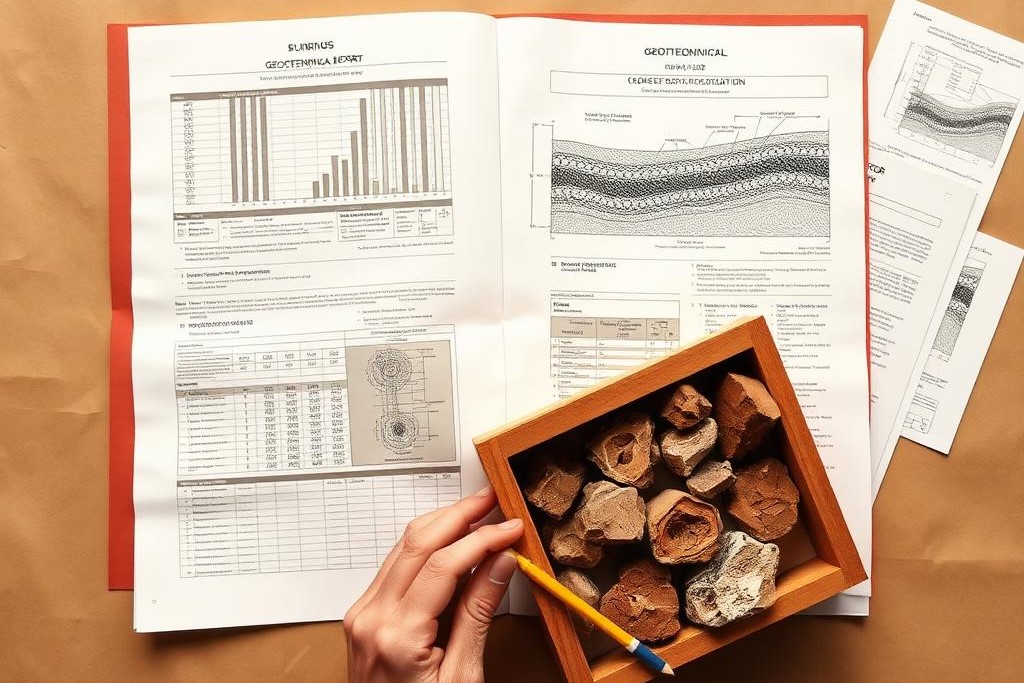
Every deep foundation drilling project in this country begins with a story. It’s a story about what lies beneath the surface, written in the language of soil mechanics and rock properties. That story is the geotechnical report. For a drilling contractor, it’s more important than the architectural drawings, the project schedule, or the site logistics plan. It is the single document that dictates the means, methods, cost, and risk of the entire job. How our team at DrillingCrust and our operating partners interpret that report is what separates a profitable, on-schedule project from a financial disaster bogged down in delays and changed conditions. Before our CZM LR160 rig is even loaded onto a Western Star lowboy, our most experienced people are poring over that report, reading between the lines to understand the real job ahead.
First Stop: The Boring Logs
An experienced drilling estimator doesn’t start with the executive summary. They flip straight to the appendices, to the boring logs. This is the raw data, the ground truth of the project. These logs are a vertical diary of what the geotechnical engineer’s exploratory rig found when it drilled small-diameter test holes across the site. We’re looking for the narrative of the ground, layer by layer. How thick is the topsoil and fill? What lies beneath it? Is it 40 feet of uniform, stiff clay, or is it a miserable layer cake of running sand, soft clay, and cobbles?
Each line item tells us something critical. The Standard Penetration Test (SPT) ‘N-value’, or blow counts, tells us the density of the soil. A low blow count in sand tells our operator they’ll need to be ready for the hole to squeeze in on them, demanding casing or drilling fluid. A high blow count in a dense clay tells us our production will be slower. We’re cross-referencing this with the soil descriptions a few columns over. Is it a CH (high-plasticity clay) or a SP (poorly graded sand)? That tells us how the material will behave on the auger and how it will pile up on the ground when we spin it off.
The location and number of borings are just as important as what’s in them. A 10-acre site for a new data center with only three boring logs is a field of red flags. What’s in the 500 feet between borings? That’s where the risk lies. Conversely, a tight grid of borings gives us high confidence. We can build a mental 3D model of the site, anticipating where the soil transitions will occur. This is where experience pays off; we’re not just reading the data, we’re visualizing the site and planning every rotation of the auger before we even arrive.
Groundwater Changes Everything
The second thing we look for, often right on the boring log, is the static water level. A note that reads ‘Groundwater encountered at 12 feet below existing grade’ can have more impact on the budget than any other single data point. The moment you introduce water into a drilled shaft, you’ve entered a new realm of complexity and cost. An open hole in dry, stable clay is one thing. An open hole below the water table is actively trying to collapse.
The presence of groundwater immediately forces a decision: casing or slurry. Temporary steel casing is the most straightforward solution. We advance a section of pipe into the ground to seal off the water and unstable soil layers, drill the shaft out from within it, and then pull the casing as we fill the shaft with concrete. Casing costs money to rent and transport, and it takes rig time to install and extract. It’s a major schedule and cost consideration that has to be priced into the bid. For a project with 100 shafts, the difference between a ‘dry’ job and a ‘wet’ job can be weeks of rig time and hundreds of thousands of dollars in casing rental.
The alternative is drilling under fluid, typically a polymer or bentonite slurry. The weight and properties of the slurry provide the hydrostatic pressure to keep the hole open and the water out. This eliminates the time spent setting and pulling casing, but introduces its own challenges. It requires tanks, pumps, and personnel to manage the slurry. More importantly, it creates a massive amount of wet, messy spoils. Instead of a neat pile of soil that a Cat 299D3 track loader can easily manage, you have a soupy mess that must be contained, dewatered, and disposed of, often at a significant extra cost. The choice between casing and slurry is a strategic one, driven entirely by that single line in the geo report about the water table.
Decoding Rock Sockets
For the massive structures we support, from transmission towers for the power grid to the foundation of a semiconductor fab, shafts often don’t just stop in soil. They are socketed into bedrock to achieve the immense capacities required. When the word ‘rock’ appears in the report, we turn to a different set of data: the rock core logs. Here, we analyze the Rock Quality Designation (RQD) and the Unconfined Compressive Strength (UCS).
RQD is a measure of the integrity of the rock mass. It’s calculated as the percentage of recovered core pieces that are four inches or longer. A 90% RQD in a limestone suggests solid, competent rock that will drill cleanly and provide excellent performance. A 30% RQD in the same limestone suggests a fractured, blocky mess that will be difficult to drill, may break apart, and will offer questionable bond strength. This tells us what kind of tooling will be on the hook of our CZM LR160. A high-RQD, moderate-strength rock might be handled by an aggressive rock auger. A low-RQD formation might require a core barrel to contain the fractured pieces, and very hard rock, like granite with a UCS over 20,000 psi, will require specialized tooling and a much slower, more deliberate approach.
The engineer’s design will specify a socket of a certain diameter and length based on an assumed bond strength between the concrete and the rock. Our job is to look at the core logs and decide if that assumption is realistic. If the design calls for a 10-foot socket but the core log shows the top five feet of rock is basically rubble (low RQD), we know we’ll likely have to drill deeper to get the required capacity in competent rock. This is a crucial clarification to make before the bid is submitted. Going back to an owner mid-project to ask for more money to drill deeper sockets because the rock quality wasn’t what was assumed is a conversation no one wants to have.
The Engineer
After digesting the raw data, we turn our attention to the body of the report where the geotechnical engineer provides their analysis and recommendations. This section is the bridge between the data and the design. The engineer will recommend a specific foundation type, such as drilled shafts, and provide the design parameters to be used, like the ultimate end bearing pressure and the skin friction values for each soil layer.
We scrutinize these values against our own experience. If the engineer assigns a high skin friction value to a soft clay layer, we might be skeptical. This could make the design seem more efficient on paper, but if that capacity isn’t really there, it creates risk for the structure. We are also looking for consistency. If the recommendations seem disconnected from the data in the boring logs, it’s a sign that we need to ask more questions and potentially call for a pre-bid meeting with the engineer to clarify their intent.
This section also contains other vital information, such as seismic site classification. For a project in a seismically active area, the design of the shafts, particularly the amount and detailing of the steel reinforcement cage, will be much more robust and complex. This impacts the cost of the rebar and the time it takes for our crews to safely handle and place the heavier cage into the shaft. Understanding these recommendations helps us see the full picture of what the designer expects and what the project will demand from our equipment and our team.
From Report to Rig: Building the Bid
The geotechnical report is the blueprint for our bid. Every piece of data is translated into time and money. We start with production rates. Based on the soil layers and blow counts in the boring logs, we can estimate how many feet per hour our LR160 can drill. 'Ten feet of soft clay, 20 feet of medium dense sand, then 15 feet of stiff clay.' To us, that’s not just soil, that’s a calculation: 0.5 hours for the soft clay, 1.2 hours for the sand requiring casing, 1.5 hours for the stiff clay. We add time for setting casing, for tripping the kelly bar, for cleaning the auger.
We factor in tooling. A clean clay job means standard dirt tools. The appearance of cobbles or weak rock in the logs means we need to budget for a rock auger and expect higher wear and tear on the teeth. Hard rock sockets mean budgeting for a core barrel and slow, hard-won progress. Each tool has a cost, and the report tells us which ones to bring. The cost of fuel, the number of crew members, the need for a full-time operator for a Cat 308 excavator to manage spoils—it all traces back to the soil descriptions and water levels.
Finally, we price the risk. A thorough, detailed report with many borings allows for a tight, competitive bid. A sparse, vague report with only a few borings across a large site is a gamble. The ground between the borings is a question mark. Will we hit an old foundation? A nest of boulders? A sand lens that wasn't on any of the logs? In these cases, our bid has to include a contingency to cover that uncertainty. The geotechnical report, in the end, determines not just the price, but the confidence with which we can offer that price.
When the Ground Breaks the Rules
There’s an old saying in the industry: 'The geo report is a prediction, but the ground has the final vote.' No matter how thorough the investigation, surprises happen. The most important contractual clause for a drilling contractor is the 'changed conditions' clause. This is the mechanism for dealing with reality when it diverges from the report.
Imagine we’re drilling shafts for a new EV battery plant. The report showed uniform sand, and we’ve based our entire bid on drilling with temporary casing. On the fifth shaft, our auger hits refusal at 20 feet. It’s not rock—it’s the roof of a massive, buried concrete structure from a previous use of the site, something the borings all managed to miss. Our tooling can’t penetrate it. Work stops. Now, the process begins. We document everything: drilling logs, photos, survey data. We notify the general contractor immediately. A meeting is convened. The solution might involve mobilizing a larger rig with demolition tools, or a complete redesign of the foundation element. The key is that because the condition differs materially from what was indicated in the geotechnical report, it’s a compensable change.
This is where a drilling contractor’s expertise is truly tested. It’s not just about drilling the holes; it’s about solving the problems the ground presents. Having a deep understanding of the geotechnical report is our primary tool in this process. It allows us to demonstrate clearly what was expected versus what was found, forming the basis for a fair and equitable resolution. It protects us from having to absorb the cost of the earth’s surprises, and it ensures the owner gets the foundation they need, even if the path to get there is different than everyone planned.
Every commercial drilling job starts with a geotechnical report. It is the closest thing the industry has to a set of instructions for the ground itself — boring logs, lab test results, groundwater observations, and recommended foundation systems. How a contractor reads it shapes the bid, the schedule, and the risk profile of the entire project.
Boring logs come first
Experienced crews go straight to the boring logs. Layer thicknesses, blow counts, and rock quality designations tell them what tooling to bring, how fast production will realistically be, and where casing or slurry will be needed. A log that shows loose sand over hard rock is a very different project from one that shows uniform stiff clay.
Groundwater and its consequences
Groundwater elevation drives casing strategy, spoil handling, and concrete placement method. Ignoring it in a bid is one of the fastest ways to blow up margins on a drilled shaft project.
Rock cores and socket assumptions
For any project that involves rock sockets, the rock core samples are the most important pages in the report. Recovery percentages, RQD values, and observed jointing tell the contractor how the socket will actually cut — and whether the assumed socket length is realistic.
The takeaway
Reading a geotechnical report well is a competitive advantage. It is how a drilling contractor prices risk fairly, avoids surprises, and delivers on schedule.
Working in commercial drilling?
Reach out to a DrillingCrust representative to talk projects, partnerships, or the fleet.

A holding company operating across the U.S. commercial drilling industry. We invest capital, provide funding, and lease equipment to established operators building the foundations of modern American infrastructure.
Contact
© 2026 DrillingCrust Holdings LLC. All rights reserved.